✨ New Arrivals Just Dropped!Explore
Plato's Theory of Knowledge
Translated by the noted classical scholar Francis M. Cornford, this edition of two masterpieces of Plato's later period features extensive ongoing commentaries by Cornford that provide helpful background information and valuable insights. Both works pose eternal questions that keep these dialogs ever-relevant not only for students of philosophy but also for every reader and thinker. The Theatetus offers a systematic treatment of the question, "What is knowledge?" Most of the dialog takes place between Socrates and the student Theatetus. Among the answers they explore: knowledge as perception; knowledge as true belief; knowledge as true belief plus an account (i.e., a justified true belief); as well as variations on each of these answers. Like most Socratic dialogs, the Theatetus ends without a definitive answer — leaving the subject open for the reader's further consideration. In the Sophist, a related dialog, Plato redefines the term "sophist," which hitherto had connoted one who gives sophia (wisdom) to his disciples. Plato depreciated the term, and ever since, in philosophy, sophistry indicates the deceptive exploitation of linguistic ambiguities. The dialog follows Socrates' cross-examination of a self-proclaimed true philosopher, The Stranger, on the distinction between philosophers, statesmen, and sophists.
Unabridged republication of the edition published by the Bobbs-Merrill Company, Inc., Indianapolis, Indiana, 1957.
$4.20
Original: $12.00
-65%Plato's Theory of Knowledge—
$12.00
$4.20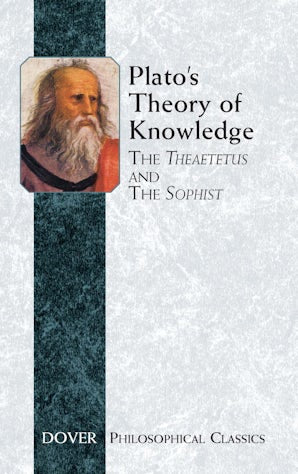
Description
Translated by the noted classical scholar Francis M. Cornford, this edition of two masterpieces of Plato's later period features extensive ongoing commentaries by Cornford that provide helpful background information and valuable insights. Both works pose eternal questions that keep these dialogs ever-relevant not only for students of philosophy but also for every reader and thinker. The Theatetus offers a systematic treatment of the question, "What is knowledge?" Most of the dialog takes place between Socrates and the student Theatetus. Among the answers they explore: knowledge as perception; knowledge as true belief; knowledge as true belief plus an account (i.e., a justified true belief); as well as variations on each of these answers. Like most Socratic dialogs, the Theatetus ends without a definitive answer — leaving the subject open for the reader's further consideration. In the Sophist, a related dialog, Plato redefines the term "sophist," which hitherto had connoted one who gives sophia (wisdom) to his disciples. Plato depreciated the term, and ever since, in philosophy, sophistry indicates the deceptive exploitation of linguistic ambiguities. The dialog follows Socrates' cross-examination of a self-proclaimed true philosopher, The Stranger, on the distinction between philosophers, statesmen, and sophists.
Unabridged republication of the edition published by the Bobbs-Merrill Company, Inc., Indianapolis, Indiana, 1957.